Tuesday, February 26, 2019

TIAA CREF Investment Management LLC Trims Position in Summit Financial Group, Inc. (SMMF)

TIAA CREF Investment Management LLC decreased its position in shares of Summit Financial Group, Inc. (NASDAQ:SMMF) by 4.3% in the third quarter, according to the company in its most recent disclosure with the Securities and Exchange Commission. The fund owned 21,311 shares of the bank’s stock after selling 969 shares during the period. TIAA CREF Investment Management LLC owned 0.17% of Summit Financial Group worth $495,000 at the end of the most recent reporting period.

A number of other institutional investors and hedge funds have also recently added to or reduced their stakes in SMMF. Vanguard Group Inc boosted its position in Summit Financial Group by 0.3% in the 3rd quarter. Vanguard Group Inc now owns 389,020 shares of the bank’s stock worth $9,029,000 after purchasing an additional 1,142 shares in the last quarter. MetLife Investment Advisors LLC boosted its position in Summit Financial Group by 54.9% in the 3rd quarter. MetLife Investment Advisors LLC now owns 8,836 shares of the bank’s stock worth $205,000 after purchasing an additional 3,131 shares in the last quarter. Dimensional Fund Advisors LP boosted its position in Summit Financial Group by 16.9% in the 3rd quarter. Dimensional Fund Advisors LP now owns 114,382 shares of the bank’s stock worth $2,655,000 after purchasing an additional 16,500 shares in the last quarter. BlackRock Inc. lifted its position in shares of Summit Financial Group by 0.8% during the 3rd quarter. BlackRock Inc. now owns 558,574 shares of the bank’s stock valued at $12,965,000 after buying an additional 4,452 shares in the last quarter. Finally, SG Americas Securities LLC purchased a new position in shares of Summit Financial Group during the 3rd quarter valued at approximately $228,000. 25.66% of the stock is owned by hedge funds and other institutional investors.

Get Summit Financial Group alerts:

In other news, Director Duke A. Mcdaniel sold 2,296 shares of the stock in a transaction that occurred on Monday, February 4th. The stock was sold at an average price of $23.56, for a total transaction of $54,093.76. The sale was disclosed in a document filed with the SEC, which is available at the SEC website. Company insiders own 7.97% of the company’s stock.

A number of research analysts have recently issued reports on SMMF shares. BidaskClub upgraded Summit Financial Group from a “hold” rating to a “buy” rating in a research report on Thursday, January 17th. Zacks Investment Research upgraded Summit Financial Group from a “sell” rating to a “hold” rating in a research report on Wednesday, December 26th. Finally, ValuEngine upgraded Summit Financial Group from a “sell” rating to a “hold” rating in a research report on Monday, February 4th.

Shares of NASDAQ:SMMF opened at $24.45 on Friday. Summit Financial Group, Inc. has a 1 year low of $17.94 and a 1 year high of $28.00. The company has a market cap of $302.37 million, a PE ratio of 10.73, a price-to-earnings-growth ratio of 1.43 and a beta of 0.93. The company has a debt-to-equity ratio of 0.10, a quick ratio of 0.90 and a current ratio of 0.90.

Summit Financial Group (NASDAQ:SMMF) last announced its earnings results on Tuesday, January 29th. The bank reported $0.60 earnings per share (EPS) for the quarter, beating analysts’ consensus estimates of $0.54 by $0.06. Summit Financial Group had a return on equity of 13.40% and a net margin of 24.88%. The firm had revenue of $22.24 million for the quarter, compared to analyst estimates of $22.02 million. Sell-side analysts expect that Summit Financial Group, Inc. will post 2.12 EPS for the current fiscal year.

ILLEGAL ACTIVITY WARNING: This piece of content was originally reported by Ticker Report and is the property of of Ticker Report. If you are viewing this piece of content on another website, it was stolen and republished in violation of international trademark & copyright legislation. The legal version of this piece of content can be viewed at https://www.tickerreport.com/banking-finance/4173772/tiaa-cref-investment-management-llc-trims-position-in-summit-financial-group-inc-smmf.html.

About Summit Financial Group

Summit Financial Group, Inc operates as a financial holding company for Summit Community Bank, Inc that provides community banking and other financial services to individuals and businesses primarily in the Eastern Panhandle and South Central regions of West Virginia and the Shenandoah Valley, and Southwestern regions of Virginia.

Further Reading: Dividend Achievers

Want to see what other hedge funds are holding SMMF? Visit HoldingsChannel.com to get the latest 13F filings and insider trades for Summit Financial Group, Inc. (NASDAQ:SMMF).

Institutional Ownership by Quarter for Summit Financial Group (NASDAQ:SMMF)

Thursday, February 21, 2019

Anthem Inc (ANTM) Files 10-K for the Fiscal Year Ended on December 31, 2018

Anthem Inc (NYSE:ANTM) files its latest 10-K with SEC for the fiscal year ended on December 31, 2018. Anthem Inc is a health benefits company offering a network-based managed care plans to the large and small employer, individual, Medicaid and Medicare markets. Its business segments are Commercial and Specialty Business, Government Business and Other. Anthem Inc has a market cap of $80.94 billion; its shares were traded at around $312.95 with a P/E ratio of 22.05 and P/S ratio of 0.89. The dividend yield of Anthem Inc stocks is 0.96%. Anthem Inc had annual average EBITDA growth of 9.20% over the past ten years. GuruFocus rated Anthem Inc the business predictability rank of 4-star.

For the last quarter Anthem Inc reported a revenue of $23.4 billion, compared with the revenue of $22.7 billion during the same period a year ago. For the latest fiscal year the company reported a revenue of $92.1 billion, an increase of 2.3% from last year. For the last five years Anthem Inc had an average revenue growth rate of 5.8% a year.

The reported diluted earnings per share was $14.19 for the year, a decline of 1.1% from the previous year. Over the last five years Anthem Inc had an EPS growth rate of 12.5% a year. The profitability rank of the company is 4 (out of 10).

At the end of the fiscal year, Anthem Inc has the cash and cash equivalents of $3.9 billion, compared with $3.6 billion in the previous year. The long term debt was $17.2 billion, compared with $17.4 billion in the previous year. Anthem Inc has a financial strength rank of 5 (out of 10).

At the current stock price of $312.95, Anthem Inc is traded at 104% premium to its historical median P/S valuation band of $153.42. The P/S ratio of the stock is 0.89, while the historical median P/S ratio is 0.44. The intrinsic value of the stock is $184.05 a share, according to GuruFocus DCF Calculator. The stock gained 33.86% during the past 12 months.

Directors and Officers Recent Trades:

EVP & Chief Administrative Off Gloria M Mccarthy sold 7,700 shares of ANTM stock on 02/04/2019 at the average price of $302.98. The price of the stock has increased by 3.29% since.Director Julie A Hill sold 500 shares of ANTM stock on 01/31/2019 at the average price of $299.75. The price of the stock has increased by 4.4% since.

For the complete 20-year historical financial data of ANTM, click here.

Wednesday, February 20, 2019

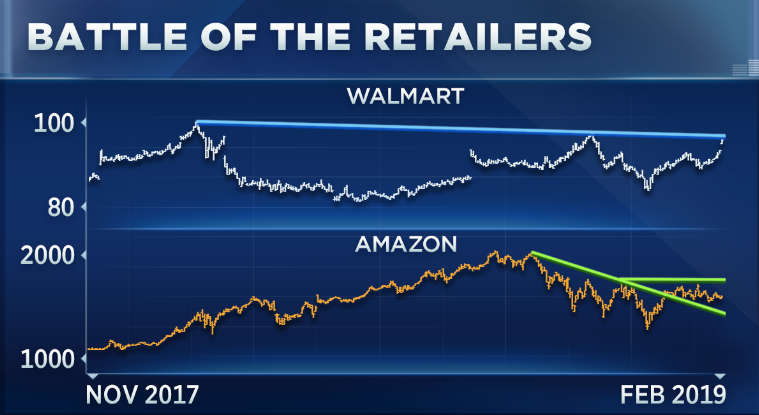
Walmart is quietly outperforming Amazon this year

It may seem like Amazon is unstoppable when it comes to e-commerce, but another retailer is hot on its tail: Walmart.

Shares of the retail giant gained as much as 4 percent Tuesday after the company topped Street estimates for earnings and revenue. The company also said that online sales grew 43 percent during the all-important holiday quarter.

Walmart stock has been the clear winner over archrival Amazon in the past six months, with shares rising 5 percent versus Amazon's 14 percent slide.

While some might see Walmart's gain as Amazon's loss and vice-versa, Oppenheimer's Ari Wald and Chantico Global's Gina Sanchez argue that these stocks can co-exist, and that there's upside for each one in the long term.

"I don't think it's an 'either or' thing when discussing these two stocks. In fact, we think they both can work higher together … [we have] both Walmart and Amazon.com on our S&P 500 buy list," Wald said Tuesday on CNBC's "Trading Nation."

Wald likes Walmart at current levels because he says the stock chart indicates it is firmly in an uptrend. He noted that the stock is "coming into an important test of its trend of lower highs dating back to early 2018" and that investors should "stick with this strength" in order to play "the breakout based on good relative strength."

He also says the retailer is beating its benchmark as well as the broader market, which is a sign of positive momentum. In the last three months, shares of Walmart have gained nearly 7 percent versus the S&P's 4 percent gain. Consumer staple stocks, on the other hand, have shed just over 2 percent.

Despite Amazon's recent weakness, Wald is expecting the stock to soon turn a corner based on the favorable backdrop. He believes that in a "lower-growth world," investors will give a premium to higher-growth companies, like Amazon, which is trading above $1,627.

The key number he's watching is $1,780, which has been a resistance level for the stock in recent months. From a technical standpoint, that means that the stock has repeatedly reached that level, but that it has failed to break through and bounce higher from that price.

Wald notes that Amazon is "building this base below $1,780 resistance," which he says means it will "ultimately break higher."

Like Wald, Chantico Global's Gina Sanchez believes investors can own both Walmart and Amazon.

When it comes to Walmart, she specifically likes the sustained growth the company has shown in e-commerce sales.

"Walmart has been putting a significant amount of effort and money behind building out their online services and they're starting to see some returns from that," she said.

Sanchez also likes Amazon for the long term, attributing much of the recent weakness to a temporary slowdown in the company's lucrative web services segment.

"Amazon Web Services has actually been a huge grower for them, and that whole cloud area is actually slowing a bit. You're seeing that in the chip stocks, you're seeing that play out in other spaces, so while that was a huge benefit for Amazon, it's probably just sort of becoming a little more of a laggard. But long term we do think that that's a great play for Amazon, and so I wouldn't count Amazon out here by any stretch of the imagination," she said.

Amazon is currently trading in a bear market, with shares falling just over 20 percent from their 52-week intraday high of $2,050.50 from September.

Disclaimer

Tuesday, February 19, 2019

Baidu and iQiyi Have a Lot to Prove This Week

China's leading search engine and the fast-growing video-streaming site it spun off last year will be giving investors new numbers to mull over in a few days, as Baidu (NASDAQ:BIDU) and its iQiyi (NASDAQ:IQ) spinoff will report their fourth-quarter results after Thursday's market close. Conference calls for both companies will follow later that evening. 

Both stocks are trading well below last year's highs. Baidu and iQiyi have plunged 40% and 53% since last year's springtime peaks. A strong financial report this week can help these former dot-com darlings claw their way back into the market's favor.

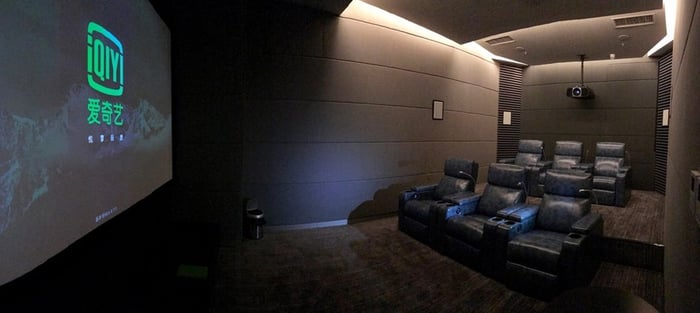
An iQiyi private theater.

Image source: iQiyi.

Earning a turnaround

Baidu's guidance back in October was calling for revenue to climb 15% to 20% in the fourth quarter. China's weakening economy has analysts now settling for a mere 14% in top-line growth. This is shaping up to be Baidu's slowest quarterly growth in nearly two years, but things aren't as bad as the reported results would make it seem. Baidu has been selling off some of its non-core businesses lately, and its guidance adjusted for those asset sales would be calling for 20% to 26% in revenue growth.

Wall Street sees earnings per share sliding to $1.78 for the quarter, down from $2.15 a year earlier. Net income has been expanding lately as Baidu doubles down on its high-margin core businesses, but China's faltering economy and Baidu's own new growth initiatives could be weighing on bottom-line results. The silver lining is that Baidu has beaten analyst profit targets by a double-digit-percentage basis every single quarter over the past year.

iQiyi is growing a lot faster than Baidu. The $943.5 million to $982.8 million it was targeting in revenue four months ago represents a 43% to 49% increase from the prior year's fourth quarter. Analysts are perched at the high end of that range.

The bottom line is another story. iQiyi's video-streaming platform is growing in popularity, but it's still years away from profitability, and Wall Street's bracing for another big deficit. iQiyi has posted larger losses than expected in its brief tenure as a public company.

A strong report by one or both companies can push the stocks higher, but investors will also be looking for signs of improvement. If Baidu can make progress beyond paid search, and if iQiyi can gain momentum with its premium subscriptions, it would go a long way toward making investors overlook any near-term financial hiccups. 

Baidu and iQiyi are at different points in their growth cycles. Baidu has become a contrarian play, falling out of favor with growth investors and now a compelling value play, with its earnings multiple in the teens. iQiyi has more of the racing stripes that growth investors like to see, given its heady growth rate and its compelling niche, but it's in the wrong place at the wrong time as investors steer clear of Chinese growth stocks. They're both cheap investments, but a rough quarter could make them even cheaper.

Monday, February 18, 2019

Wealthtech Nutmeg Doubles Down With Goldman's Investment For Global Expansion

&l;p&g;&l;img class=&q;dam-image getty size-large wp-image-824928050&q; src=&q;https://specials-images.forbesimg.com/dam/imageserve/824928050/960x0.jpg?fit=scale&q; data-height=&q;639&q; data-width=&q;960&q;&g; Getty

UK wealthtech &l;a href=&q;https://www.nutmeg.com/&q; target=&q;_blank&q;&g;Nutmeg r&l;/a&g;ecently completed a &l;a href=&q;https://www.fnlondon.com/articles/goldman-sachs-takes-stake-in-uk-wealth-manager-nutmeg-20190122&q; target=&q;_blank&q;&g;funding round of $58 million for global expansion co-led by Goldman Sachs.&l;/a&g; The move will likely see Goldman position Nutmeg alongside its retail savings platform Marcus.

Schroders, the 200 year old UK asset manager was an early investor in Nutmeg. Last year, &l;a href=&q;https://www.reuters.com/article/us-blackrock-scalablecapital-idUSKBN19A322&q; target=&q;_blank&q;&g;Blackrock took a stake in the Anglo-German robo&a;nbsp;Scalabeable Capital&l;/a&g; to help it expand, following an investment in&a;nbsp;&l;span&g;U.S. robo&a;nbsp;FutureAdvisor, which is selling B2B solutions to legacy wealth managers.&l;/span&g;

Tradition financial institutions and especially legacy banks are spending billions on technology and innovation to deliver digital solutions to better appeal to consumers, at the same time as driving down costs.

&l;span&g;Banks like JPMorgan and Wells Fargo have been working on their own robo solutions with Wells launching ThinkAdvisor. These along with startup robos in the U.S. like Wealthfront and Betterment are all competing with legacy asset managers like Vanguard, Fidelity and Charles Schwab all of whom have launched their own robo platforms.&l;/span&g;

One of the big focus areas in on the main prize - a new segment&a;nbsp;of digitally savy&a;nbsp;&l;a href=&q;https://communityrising.kasasa.com/gen-x-gen-y-gen-z/&q; target=&q;_blank&q;&g;generation x to y &l;/a&g;millenial&a;nbsp;consumers positioned to inherit wealth over the next decade from the most successful generation of wealth accumulators in history, the baby boomers - their parents and grandparents.

Nutmeg was founded by &l;a href=&q;https://www.linkedin.com/in/nick-hungerford-781a6713/&q; target=&q;_blank&q;&g;Nick Hungerford&l;/a&g;, a former Barclays Banker and Stanford University post-graduate who saw the early opportunities in wealthtech. Nick now sits on the Board of Nutmeg, overseeing his creation and resides in Singapore where he is busy in the community with a number of exciting projects.

An early mover and visionary in the fintech space, Nick was a co-founder of Innovate Finance, the U.K.&s;s not-for-profit fintech members association, and a fellow board member during my tenure as CEO in the halcyon days of our member growth and fintech ecosystem building.

I sat down with Nick to talk about what attracted Goldman&a;nbsp;to Nutmeg, the strengths of Nutmeg&a;rsquo;s offering, the future of the Wealth Management sector, and what&s;s going on in the Singapore fintech community.

&l;strong&g;Lawrence Wintermeyer: &l;/strong&g;What attracted Goldman Sachs to invest in Nutmeg in this latest round?

&l;strong&g;Nick Hungerford: &l;/strong&g;I believe there are three primary reasons: first, they see the potential of Nutmeg as a stand-alone business and the opportunity for financial return as a shareholder. Second, the opportunity for partnership development and the chance that Nutmeg can be rocket fuel for the Goldman strategy to move more into the retail market. Third, shared insights and vision: Nutmeg can learn a lot from Goldman and hopefully, Goldman will learn a bit from us. The learnings aren&a;rsquo;t just about financial products and investing, for example, Goldman has a huge number of amazing engineers Nutmeg can learn tech skills from. We can discuss culture and customer insights etc.

&l;strong&g;Lawrence Wintermeyer: &l;/strong&g;With $1.5 billion in assets under management, Nutmeg has become a scale wealthech player, what are the new global markets on the roadmap,&a;nbsp; will we see Nutmeg entering the US market?

&l;strong&g;Nick Hungerford: &l;/strong&g;First of all Nutmeg will focus on consolidating our dominant position in the UK and scaling into Asia. After that, and on a selective basis, we will look to Europe and the US. Our partnerships with Goldman, Fubon and Convoy set us up well for international expansion.

&l;strong&g;Wintermeyer: &l;/strong&g;The client proposition and user engagement platform in Nutmeg is recognized for standing out in a crowded marketplace, what&a;rsquo;s in the secret sauce that attracts and retains customers to the platform?

&l;strong&g;Hungerford: &l;/strong&g;Funnily enough given the recent Goldman announcement, I said in 2012 that I wanted customers of Nutmeg to feel like they were walking into Goldman Sachs&a;rsquo; Private Bank when they became customers of Nutmeg. It&a;rsquo;s a simple ethos to overly commit to giving our clients great service &a;ndash; more than that, great care &a;ndash; when they work with us. It&a;rsquo;s about sharing their experiences, for example feeling the pain when markets fall, by being customers ourselves. There are lots of technical answers to this question as well: we try and learn more about our customers all of the time to provide them with a personalized experience and so on. But the real secret lies in the care and concern that we have to ensure no Nutmeg customer feels anything other than we are doing all we can for them.

&l;strong&g;Wintermeyer: &l;/strong&g;Consumers have moved from actively managed funds to passive funds and ETFs in large scale in the West, and we are seeing a rise in &a;ldquo;algos&a;rdquo; for systematic investment management and all of these trends are leading to lower costs for investors.&a;nbsp; What is Nutmeg&s;s underlying investment management strategy?

&l;strong&g;Hungerford: &l;/strong&g;Our belief is that investors should focus on asset allocation to determine the risk reward balance (or target) and then implement that strategy using the lowest cost methodology possible. Clearly, this has to be low cost within reason and we need to factor in liquidity of securities, etc. Time and again cost have been shown to be critical drivers of returns.

&l;strong&g;Wintermeyer: &l;/strong&g;2018 saw greater volatility emerge in most asset classes with the equity markets underperforming the previous years&a;rsquo; bull run. How will the wealthtech challengers survive a downturn and poor performance in the equity markets?

&l;strong&g;Hungerford:&l;/strong&g; I don&a;rsquo;t think all wealthtech or fintech companies will survive a prolonged downturn. There are circa 550 &a;ldquo;Nutmegs&a;rdquo; around the world now and it&a;rsquo;s hard to see how they can all compete when customer acquisition costs mean that payback is not instant. I think we will see two or three major players in each region emerge.

&l;strong&g;Wintermeyer: &l;/strong&g;A number of successful challenger wealthtechs including Nutmeg now have legacy wealth management shareholders. How challenging is the future market for legacy wealth managers? Is investment in wealthtech challengers part of a strategy for incumbents to meet those future challenges?

&l;strong&g;Hungerford: &l;/strong&g;I think it&a;rsquo;s a smart strategy for them! I happen to think &a;ndash; and this is not a view shared by all of my wealthtech peers &a;ndash; that there is still a place, and lots to learn, from incumbent wealth managers. Many of them offer a great service to their clients, they have moments of innovation brilliance and there excellent leaders in some companies. That said, they have aging client bases and must adapt to changing digital times. Nutmeg can&a;rsquo;t get complacent: as the oldest digital wealth manager people will be calling us legacy soon!

&l;strong&g;Wintermeyer: &l;/strong&g;What is the story behind why you started Nutmeg and what were the early days of the journey like?

&l;strong&g;Hungerford: &l;/strong&g;I don&a;rsquo;t want to think about it! I was moving between friends houses in California, then the same in London before my sister and her now husband took me in. I was constantly getting rejected by investors who said that there was no way regulators would allow wealth management to be done without a face to face relationship. And of course, I wasn&a;rsquo;t earning any money! The passion was there because I had friends and family who wanted to be doing more with their money than just putting it in a zero percent deposit account. And I&a;rsquo;d worked in wealth management and knew that investing was eminently scalable.

&l;strong&g;Wintermeyer: &l;/strong&g;You moved from Tier 1 banker to Nutmeg founder&a;nbsp;and entrepreneur CEO, to Nutmeg board member and now venture capitalist. How has this journey been for you and what are some of your biggest lessons learned?

&l;strong&g;Hungerford: &l;/strong&g;My two biggest lessons would be first, humility. It&a;rsquo;s definitely something I lacked in banking because you have such smart, amazing people around you that you don&a;rsquo;t realize you are being carried along and start to believe your own hype. There is none of that in entrepreneurship, whereas a founder you are resupplying the toilet roll and constantly getting told your idea sucks. Second, loyalty. The shareholders who give you money at the start deserve huge credit. And I&a;rsquo;m so grateful to them. They will get first dibs on future businesses I start!

&l;strong&g;Wintermeyer: &l;/strong&g;You are now based in Singapore,&a;nbsp; what is your outlook for the fintech in Asia, and how key is the Singapore hub to the development of the fintech ecosystem in South Asia?

&l;strong&g;Hungerford: &l;/strong&g;Fintech here is taking off, with tremendous learning from overseas facilitating startups and of course some amazing companies in China that I think are some years ahead of anything in the U.S. or U.K. There are amazing possibilities for entrepreneurs here. However, there are structural issues &a;ndash; particularly in South East Asia &a;ndash; where the lack of passporting between countries means that there are small markets to go after.

With some more cooperation between regulators and governments, I can see South East Asia becoming possibly the world&a;rsquo;s leading fintech hub. Singapore is leading the way and has a regulator challenging the FCA for the title of world&a;rsquo;s most progressive. They need more countries around to follow their lead. For fintech enterprises outside of Asia it&a;rsquo;s critical they keep one eye on what&a;rsquo;s happening here if they don&a;rsquo;t want to be left behind.

&l;em&g;Nick Hungerford is a former banker and the founder of Nutmeg and is&a;nbsp;passionate about improving the availability and usability of financial products and services, financial literacy and the role of&a;nbsp;technology and innovation&a;nbsp;within the finance sector.&l;/em&g;

&a;nbsp;&l;/p&g;

Sunday, February 17, 2019

7 Financial Stocks With Accelerating Growth

Usually, when I run my detailed screens across my huge Portfolio Grader database, I have a pretty good idea of what is likely to show up. Not this time …

I figured that when I ran a screen for companies that were seeing accelerated growth I would see some financial technology (fintech) stocks that were coming back from last year’s beating, or I would see a bunch of banks or financial services providers.

What I didn’t expect was a slew of real estate investment trusts (REITs) woven in with interesting financial companies. But that’s what I got. Surprises like this are good for your portfolio … it means my selection process is still objective — otherwise, I wouldn’t be able to surprise myself!

The seven financial stocks with accelerating growth that I have highlighted below include a handful of REITs in dynamic sectors, with a few top-rated financial stocks thrown in for good measure.


Compare Brokers
Rexford Industrial Realty (REXR)

Rexford Industrial Realty Inc (NYSE:REXR) is an interesting REIT in the fact that it is very focused on one particular region. Most REITs tend to specialize in a sector but diversify their markets.

REXR has chosen to keep it simple and focus on one thing (for now at least): industrial property in Southern California. Granted, this is the largest industrial market in the U.S., so there isn’t a lack of opportunity.

What’s more, the ports in Long Beach and LA are the 2 biggest ports in the U.S., so that helps keep industrial property in demand.

While REXR delivers a nice 2.1% dividend yield, it’s still in a big growth phase now. REXR stock is up nearly 19% year to date and 25% in the past 12 months. If the U.S. and China hammer out a trade deal, its upside is significantly bigger. In the fourth quarter, REXR beat on earnings and, although revenue was soft, it was up 22% year-over-year.


Compare Brokers
Ladder Capital (LADR)

Ladder Capital Corp (NYSE:LADR) is commercial property REIT that also is involved on the financial side of the game as well. It’s been around for six years now but has established itself as a very attractive income machine.

For example, last year, it delivered a nearly 8% dividend and then handed out a special dividend at the end of the year on top of it all, pushing its total dividend to above 9%.

This year, the dividend is around 7.8% (not including the special dividend) and LADR stock is up roughly 13% year to date. And this year should be a busy one for LADR since rates have slowed, it means demand will grow while rates remain low.

LADR is well diversified — both by the location of its property financing as well as the types of properties it finances — and is reasonably priced, selling at a P/E of 8.79, even after its solid run so far this year.


Compare Brokers
Community Healthcare Trust (CHCT)

Community Healthcare Trust Inc (NYSE:CHCT) has a stock chart that makes it look like it’s some high-flying tech company or biotech with a major breakthrough drug.

CHCT is up roughly 50% in the past 12 months and 24.2% year-to-date. And that doesn’t include its 4.7% dividend.

This REIT focuses on the healthcare sector, buying properties that it then leases to healthcare systems, doctors, hospitals and other healthcare service providers, like urgent care, clinics and healthcare office buildings.

Healthcare is one of those megatrends that will endure, regardless of what’s happening to the economy, or what party is in the control in Washington. As baby boomers start to hit their 60s, the rising demand for healthcare will be there whether Congress does anything or not.


Compare Brokers
Innovative Industrial Properties (IIPR)

Innovative Industrial Properties Inc (NYSE:IIPR) certainly has a dynamic name for REIT. But that’s because it is in one of the most dynamic sectors in the market today – cannabis.

IIPR owns and manages industrial properties and is one of the leaders in California in leasing facilities to state-licensed operators for medical marijuana cultivation. Since it is one of the pioneers, it has name recognition, which gives it a competitive moat, given state regulations and similar barriers to entry.

It is also a white-hot investment sector, so it’s no surprise that IIPR stock is soaring. Year-to-date it’s already up 31%, and in the past 12 months, it has delivered a 132% return.

Obviously, that kind of growth won’t be a regular thing, but even at those levels, its dividend is still around 2.2%. While it may have a few more years of this kind of growth, even once it settles down, this is a smart long-term play on this sector.


Compare Brokers
PennantPark Floating Rate Capital (PFLT)

PennantPark Floating Rate Capital Ltd (NYSE:PFLT) basically is a lender that focuses on variable rate first lien debt to middle market companies primarily in the U.S.

Basically, that means it’s a commercial lender that specializes in financing businesses with variable rate loans. This is one market that benefitted from the rising rate environment of last year.

In early February it delivered its Q4 results (FYQ1 for the company) and they showed just that. Earnings beat and revenue also beat by nearly 10%. Revenue was up 56% year-over-year.

This year, rates aren’t looking to move that much, but that means there may be more opportunity to find new customers as they look to finance new projects before rates head up again.

Its 8.7% dividend makes it a great choice for passive income, even if you don’t get a lot of stock growth.


Compare Brokers
Mastercard (MA)

Mastercard Inc (NYSE:MA) is one of the most recognizable names in the credit card industry. But that isn’t where MA is making a name for itself today. Now it’s about fintech, financial technology both on the back-end with its financial partners and on the front end, growing its brand across new markets and customers.

MA has certainly established itself as a major credit card brand. But its move into debit cards and e-commerce is really where the growth is in the U.S. market and beyond.

Some of this is apparent in its Q4 numbers. Quarterly profits were up 33% year-over-year. And considering the fact that consumer spending was actually down in 2018 compared to Q4 17, that is an impressive number.

MA said in its quarterly call that it expects revenue growth in the ‘mid-teens’ to continue through 2021. Much of that growth is happening outside the U.S., which is where MA has a significant brand presence. It’s starting to pay off.

While MA does deliver a 0.6% dividend, just reinvest those dividends and go for the growth here.


Compare Brokers
Kinsale Capital (KNSL)

Kinsale Capital Group Inc (NASDAQ:KNSL) is an insurance provider that specializes in excess and surplus (E&S) lines of insurance.

Simply put, E&S insurers provide policy coverage for homes and businesses that need coverage beyond typical property and casualty (P&C) policies. For example, E&S fills the gap for challenging and high-risk properties and business that don’t fit traditional actuarial models like mobile homes, day care centers and even properties a large as refineries.

Wherever this increased risk that can’t be covered by a broad P&C policy is where E&S comes in. And this is all KNSL focuses on, specifically small- to mid-sized accounts. That gives them a niche that many big insurers don’t spend too much time trying to woo.

The dividend is just 0.53% but it’s a solid grower — up 23.39% in the past 12 months — and is a good long-term play in a growing sector.

Louis Navellier is a renowned growth investor. He is the editor of four investing newsletters: Growth Investor, Breakthrough Stocks, Accelerated Profits and Platinum Growth. His most popular service, Growth Investor, has a track record of beating the market 3:1 over the last 14 years. He uses a combination of quantitative and fundamental analysis to identify market-beating stocks. Mr. Navellier has made his proven formula accessible to investors via his free, online stock rating tool, PortfolioGrader.com. Louis Navellier may hold some of the aforementioned securities in one or more o

Saturday, February 16, 2019

Zacks: Analysts Expect Viavi Solutions Inc (VIAV) Will Post Quarterly Sales of $260.46 Million

Analysts expect that Viavi Solutions Inc (NASDAQ:VIAV) will post sales of $260.46 million for the current quarter, Zacks Investment Research reports. Five analysts have made estimates for Viavi Solutions’ earnings, with estimates ranging from $257.30 million to $264.26 million. Viavi Solutions reported sales of $219.40 million during the same quarter last year, which would indicate a positive year over year growth rate of 18.7%. The firm is scheduled to announce its next quarterly earnings report on Thursday, May 2nd.

On average, analysts expect that Viavi Solutions will report full-year sales of $1.11 billion for the current year, with estimates ranging from $1.10 billion to $1.11 billion. For the next fiscal year, analysts forecast that the company will post sales of $1.17 billion, with estimates ranging from $1.13 billion to $1.23 billion. Zacks’ sales averages are a mean average based on a survey of research analysts that follow Viavi Solutions.

Get Viavi Solutions alerts:

Viavi Solutions (NASDAQ:VIAV) last released its quarterly earnings data on Tuesday, February 5th. The communications equipment provider reported $0.22 earnings per share (EPS) for the quarter, topping the Thomson Reuters’ consensus estimate of $0.16 by $0.06. The business had revenue of $298.40 million during the quarter, compared to analysts’ expectations of $280.93 million. Viavi Solutions had a negative net margin of 3.76% and a positive return on equity of 15.82%. The company’s revenue for the quarter was up 47.9% on a year-over-year basis. During the same period in the previous year, the company earned $0.09 EPS.

A number of research analysts have recently issued reports on the stock. Zacks Investment Research upgraded shares of Viavi Solutions from a “hold” rating to a “buy” rating and set a $13.00 price target on the stock in a research note on Saturday, February 9th. BidaskClub lowered shares of Viavi Solutions from a “strong-buy” rating to a “buy” rating in a research report on Tuesday, February 5th. TheStreet upgraded shares of Viavi Solutions from a “c” rating to a “b-” rating in a research report on Wednesday, February 6th. ValuEngine upgraded shares of Viavi Solutions from a “hold” rating to a “buy” rating in a research report on Monday, February 4th. Finally, Stifel Nicolaus began coverage on shares of Viavi Solutions in a research report on Monday, October 22nd. They set a “buy” rating and a $14.00 target price on the stock. One research analyst has rated the stock with a sell rating and eleven have given a buy rating to the company’s stock. The company has a consensus rating of “Buy” and an average price target of $12.88.

In other Viavi Solutions news, Director Keith Barnes sold 11,074 shares of the company’s stock in a transaction that occurred on Monday, November 19th. The stock was sold at an average price of $9.73, for a total transaction of $107,750.02. Following the completion of the transaction, the director now owns 98,471 shares of the company’s stock, valued at approximately $958,122.83. The transaction was disclosed in a legal filing with the SEC, which is available at this hyperlink. In the last ninety days, insiders have sold 13,149 shares of company stock valued at $127,959. Insiders own 0.50% of the company’s stock.

Several hedge funds and other institutional investors have recently added to or reduced their stakes in the company. Vanguard Group Inc. boosted its holdings in shares of Viavi Solutions by 1.8% in the 3rd quarter. Vanguard Group Inc. now owns 23,357,949 shares of the communications equipment provider’s stock valued at $264,879,000 after buying an additional 418,120 shares during the last quarter. Vanguard Group Inc lifted its holdings in Viavi Solutions by 1.8% during the 3rd quarter. Vanguard Group Inc now owns 23,357,949 shares of the communications equipment provider’s stock valued at $264,879,000 after purchasing an additional 418,120 shares during the last quarter. Dorsal Capital Management LLC lifted its holdings in Viavi Solutions by 1.1% during the 3rd quarter. Dorsal Capital Management LLC now owns 4,800,000 shares of the communications equipment provider’s stock valued at $54,432,000 after purchasing an additional 50,000 shares during the last quarter. Dimensional Fund Advisors LP lifted its holdings in Viavi Solutions by 6.8% during the 3rd quarter. Dimensional Fund Advisors LP now owns 4,165,036 shares of the communications equipment provider’s stock valued at $47,231,000 after purchasing an additional 264,230 shares during the last quarter. Finally, Northern Trust Corp lifted its holdings in Viavi Solutions by 1.3% during the 2nd quarter. Northern Trust Corp now owns 2,907,009 shares of the communications equipment provider’s stock valued at $29,768,000 after purchasing an additional 36,714 shares during the last quarter. 90.56% of the stock is owned by institutional investors.

VIAV traded up $0.15 on Tuesday, reaching $12.41. The company had a trading volume of 47,532 shares, compared to its average volume of 2,406,620. Viavi Solutions has a 1 year low of $9.11 and a 1 year high of $12.82. The stock has a market cap of $2.75 billion, a PE ratio of 36.49 and a beta of 0.84. The company has a debt-to-equity ratio of 0.80, a current ratio of 2.99 and a quick ratio of 2.70.

About Viavi Solutions

Viavi Solutions Inc provides network test, monitoring, and assurance solutions to communications service providers, enterprises, network equipment manufacturers, civil government, military, and avionics customers worldwide. The company operates through Network Enablement, Service Enablement, and Optical Security and Performance Products segments.

Read More: Price to Earnings Ratio (PE), For Valuing Stocks

Get a free copy of the Zacks research report on Viavi Solutions (VIAV)

For more information about research offerings from Zacks Investment Research, visit Zacks.com

Earnings History and Estimates for Viavi Solutions (NASDAQ:VIAV)

Friday, February 15, 2019

FedEx Co. (FDX) Shares Sold by Ballentine Partners LLC

Ballentine Partners LLC cut its stake in FedEx Co. (NYSE:FDX) by 3.4% in the 4th quarter, according to its most recent disclosure with the Securities and Exchange Commission (SEC). The firm owned 6,492 shares of the shipping service provider’s stock after selling 226 shares during the period. Ballentine Partners LLC’s holdings in FedEx were worth $1,047,000 at the end of the most recent reporting period.

A number of other institutional investors and hedge funds also recently modified their holdings of the business. R.M.SINCERBEAUX Capital Management LLC lifted its holdings in FedEx by 215.2% in the fourth quarter. R.M.SINCERBEAUX Capital Management LLC now owns 20,175 shares of the shipping service provider’s stock worth $3,255,000 after buying an additional 13,775 shares during the period. Kranot Hishtalmut Le Morim Ve Gananot Havera Menahelet LTD purchased a new position in shares of FedEx during the fourth quarter valued at approximately $3,666,000. Kranot Hishtalmut Le Morim Tichoniim Havera Menahelet LTD purchased a new position in shares of FedEx during the fourth quarter valued at approximately $1,346,000. M&T Bank Corp lifted its holdings in shares of FedEx by 0.8% during the fourth quarter. M&T Bank Corp now owns 187,782 shares of the shipping service provider’s stock valued at $30,295,000 after purchasing an additional 1,466 shares during the last quarter. Finally, LS Investment Advisors LLC lifted its holdings in shares of FedEx by 1.3% during the fourth quarter. LS Investment Advisors LLC now owns 5,801 shares of the shipping service provider’s stock valued at $936,000 after purchasing an additional 74 shares during the last quarter. Institutional investors and hedge funds own 77.98% of the company’s stock.

Get FedEx alerts:

Shares of NYSE FDX opened at $185.62 on Thursday. FedEx Co. has a twelve month low of $150.94 and a twelve month high of $266.67. The company has a market capitalization of $48.61 billion, a P/E ratio of 12.12, a PEG ratio of 0.87 and a beta of 1.60. The company has a quick ratio of 1.36, a current ratio of 1.42 and a debt-to-equity ratio of 0.85.

FedEx (NYSE:FDX) last announced its quarterly earnings data on Tuesday, December 18th. The shipping service provider reported $4.03 earnings per share for the quarter, missing analysts’ consensus estimates of $4.05 by ($0.02). FedEx had a return on equity of 24.11% and a net margin of 7.23%. The firm had revenue of $17.82 billion during the quarter, compared to analysts’ expectations of $17.71 billion. During the same quarter in the previous year, the firm earned $3.18 earnings per share. Sell-side analysts expect that FedEx Co. will post 15.92 earnings per share for the current fiscal year.

In related news, VP John L. Merino sold 2,300 shares of the business’s stock in a transaction that occurred on Monday, February 4th. The shares were sold at an average price of $182.24, for a total value of $419,152.00. Following the completion of the transaction, the vice president now directly owns 30,185 shares in the company, valued at approximately $5,500,914.40. The sale was disclosed in a document filed with the SEC, which is available through this hyperlink. Also, Director David P. Steiner acquired 7,000 shares of the firm’s stock in a transaction that occurred on Wednesday, January 2nd. The stock was purchased at an average price of $162.92 per share, with a total value of $1,140,440.00. Following the completion of the acquisition, the director now owns 25,994 shares in the company, valued at $4,234,942.48. The disclosure for this purchase can be found here. 8.50% of the stock is owned by insiders.

FDX has been the subject of several recent research reports. Daiwa Capital Markets set a $190.00 target price on shares of FedEx and gave the company a “buy” rating in a report on Thursday, December 20th. Zacks Investment Research upgraded shares of FedEx from a “sell” rating to a “hold” rating in a report on Monday, December 3rd. BMO Capital Markets lowered their target price on shares of FedEx to $245.00 and set an “outperform” rating for the company in a report on Wednesday, December 19th. They noted that the move was a valuation call. ValuEngine upgraded shares of FedEx from a “strong sell” rating to a “sell” rating in a report on Wednesday, December 26th. Finally, JPMorgan Chase & Co. reiterated a “buy” rating and set a $233.00 target price on shares of FedEx in a report on Monday, December 24th. Two investment analysts have rated the stock with a sell rating, two have assigned a hold rating and seventeen have assigned a buy rating to the company’s stock. The stock has a consensus rating of “Buy” and a consensus price target of $237.75.

TRADEMARK VIOLATION NOTICE: This piece of content was published by Ticker Report and is owned by of Ticker Report. If you are reading this piece of content on another site, it was stolen and reposted in violation of U.S. & international trademark & copyright legislation. The legal version of this piece of content can be viewed at https://www.tickerreport.com/banking-finance/4150172/fedex-co-fdx-shares-sold-by-ballentine-partners-llc.html.

About FedEx

FedEx Corporation provides transportation, e-commerce, and business services worldwide. The company's FedEx Express segment offers shipping services for delivery of packages and freight. Its FedEx Ground segment provides business and residential money-back guaranteed ground package delivery services; and consolidates and delivers low-weight and less time-sensitive business-to-consumer packages.

See Also: Coverage Ratio

Institutional Ownership by Quarter for FedEx (NYSE:FDX)

Wednesday, February 13, 2019

Veeco Instruments Inc (VECO) Q4 2018 Earnings Conference Call Transcript

Veeco Instruments Inc  (NASDAQ:VECO)Q4 2018 Earnings Conference CallFeb. 11, 2019, 5:00 p.m. ET

Logo of jester cap with thought bubble.

Image source: The Motley Fool.

Contents: Prepared Remarks Questions and Answers Call Participants Prepared Remarks:

Operator

Good day everyone and welcome to the Veeco Instruments Q4 and Fiscal Year 2018 Earnings Conference Call. As a reminder, today's call is being recorded.

And at this time, I'd like to turn the floor over to Anthony Bencivenga, Investor Relations. Please go ahead.

Anthony Bencivenga -- Investor Relations

Thank you and good afternoon, everyone. Joining me on the call today are Bill Miller, Veeco's Chief Executive Officer; and Sam Maheshwari, our Chief Operating Officer and Chief Financial Officer. Today's earnings release is available on the Veeco website. Please note that we have prepared a slide presentation to accompany today's webcast. We encourage you to follow along with the slides on veeco.com.

This call is being recorded by Veeco Instruments and is copyrighted material. It cannot be recorded or rebroadcast without Veeco's expressed permission. Your participation implies consent to our recording to the extent that this call discusses expectations about market conditions, market acceptance and future sales of the Company's products, future disclosures, future earnings expectations, or otherwise make statements about the future, such statements are forward-looking and are subject to a number of risks and uncertainties that could cause actual results to differ materially from the statements made.

These factors are discussed in the business description and Management's discussion and analysis sections of the Company's report on Form 10-K and annual report to shareholders and in our subsequent quarterly reports on Form 10-Q, current reports on Form 8-K and press releases. Veeco does not undertake any obligation to update any forward-looking statements, including those made on this call to reflect future events or circumstances after the date of such statements.

During this call, management may address non-GAAP financial measures, information regarding such non-GAAP financial measures including reconciliation to GAAP measures of performance is available on our website.

With that, I will turn the call over to Bill, for his opening remarks.

William J. Miller -- Chief Executive Officer

Thank you, Anthony. Good afternoon, everyone and thank you for joining the call. Veeco executed according to plan in Q4 and non-GAAP results were inline with guidance provided. Q4 bookings were $112 million in the quarter led by front-end semiconductor market and our backlog has grown to $288 million.

Revenue for the quarter was $99 million. We've been communicating for some time that the commodity portion of the LED business, which includes the sale of our MOCVD systems to the China LED market has been under pricing pressure and is becoming a smaller portion of our business. This trend continued in Q4. Non-GAAP gross margin was 36% and our non-GAAP operating income and non-GAAP EPS came in at a loss of $6.9 million and a loss of $0.16 respectively.

We ended the quarter with $261 million in cash and short-term investments. On our last earnings call, Sam indicated the possibility of a goodwill impairment charge in Q4. After performing the analysis, it became clear that charge was required. We recorded $123 million non-cash charge, which Sam will describe in more detail.

I would like to provide an update on the attack on our computer systems we announced on our last earnings call. Our internal investigation is largely complete. However, we're still cooperating with an ongoing law enforcement investigation. We learned that our systems have been compromised various times over a period of years. Unfortunately, it is impossible to determine the extent and impact of the compromise.

But I assure you, we take the security of our information relating to our employees, customers, and intellectual property seriously and we've taken steps and continue to work toward preventing a similar incident from occurring in the future. Lastly, although we meet our guidance as we've indicated in the past, we're reducing expenses and working toward growing our business by focusing on markets such as front-end semiconductor, compound semiconductor, and advanced packaging. I'll provide an update on our growth opportunities and Sam will provide more details on the financials. The first area, we see growth is EUV mask blanks using ion beam deposition. EUV Lithography is enabling advanced semiconductor nodes at 7-nanometer, 5-nanometer and beyond. Every EUV Lithography step requires a photomask and every photomask starts as a mask blank.

Our ion beam deposition technology which enables the production of lowest defect density EUV mask blanks is a critical element of the EUV infrastructure. Artificial intelligence and high performance computing are drivers of EUV adoption. As EUV is adopted for critical layers, the number of mask blanks required will increase. During Q4, we booked an additional EUV mask blank system and we expect another order in Q1. These are complex systems with nearly 12-month lead time and we will begin shipping our existing backlog starting Q2 this year.

The market opportunity is between $20 million and $50 million per year and Veeco is the leading provider of the specialized ion beam deposition technology. Laser annealing within the front-end semiconductor market is another area of growth. Our laser annealing technology serves a critical function in front-end semiconductor manufacturing and has been a process tool of record for manufacturing advanced logic devices from 40-nanometer down to 14-nanometer.

Concurrent with EUV adoption for leading edge nodes, we are experiencing strong demand from leading foundries for our annealing solutions.Our LSA backlog is the largest since the Ultratech acquisition. This may be an early signal for a potential inflection point in manufacturing the most advanced devices as manufacturers push device performance while facing geometry and physics limitations. Laser annealing is becoming a critical technology for the single-digit nodes driven by the demand from artificial intelligence, and high performance computing.

We've been working with foundries and IDMs for insertion in their leading edge nodes. You will recall during Q3, after an evaluation period, we received an order for a laser annealing system from a market leader for their upcoming node.

I'm pleased to announce that we received a follow on order for multiple systems. We believe this validates our laser annealing technology as well as its importance in enabling leading edge semiconductor manufacturing. This market is about $100 million annually.

The application of our MOCVD technology to the 3D Sensing VCSEL market is another exciting growth opportunity. A VCSEL or vertical-cavity surface-emitting laser is a complex semiconductor device used in optical and telecommunication.

Recently VCSELs enabled the facial recognition application to unlock your smartphone.

We expect VCSELs to proliferate into additional 3D Sensing applications, such as world-facing sensors and automotive LIDAR. VCSELs are compound semiconductors manufactured using MOCVD. Veeco has been a leader in MOCVD for many years.

Today, we have very little share of the -- this market, but we are enhancing our TurboDisc platform to produce high performance epitaxial VCSEL stacks. Excellent film performance coupled with Veeco's historic MOCVD TurboDisc advantages of productivity and cost of ownership will provide a compelling industry solution. Our superior performance and productivity is being validated by our customers and we are working closely with them to place beta tools. We believe this is a market opportunity of $100 million to $150 million per year. Our advanced packaging lithography is another source of growth. In addition to providing individual device performance, manufacturers seek to improve system performance by combining multiple chips in a single package. With megatrends such as artificial intelligence, mobile devices and autonomous vehicles, manufacturers are turning to techniques, such as fan-out wafer-level packaging and copper pillar applications to drive product performance. We have been a leader in advanced packaging lithography for several years and our systems are optimized for cost effective performance and automation. Early adopters of advanced packaging have been mobile phone manufacturers.

While this portion of the market has paused. We are seeing early adoption in DRAM applications, where we received a follow on order from a top tier DRAM manufacturer for our copper pillar application.

We believe, we have the technology and customer relationships to see growth in advanced packaging over the long term. We believe, this market is somewhere between $75 million and $100 million annually.

In summary, we are focused on three things in 2019. The first is innovation. We have a long history of helping our customers solve their toughest materials engineering challenges. We plan to continue this path by executing on our product road maps and releasing exciting new products and upgrades.

The second is to penetrate new markets and to accelerate our growth in EUV mask blanks using ion beam deposition, advanced front-end semiconductor with laser anneal, 3D Sensing VCSEL using MOCVD and advanced packaging lithography.

And lastly, we are not waiting exclusively for the growth to return to profitability.

As we have communicated, we initiated and are executing programs to reduce our operating expenses and improve our gross margins.

With that, I'll turn it over to Sam for further details on the financials.

Shubham Maheshwari -- Executive Vice President, Chief Financial Officer and Chief Operating Officer

Thanks, Bill and good afternoon, everyone. Today, I will be discussing our non-GAAP financial performance. You can find a detailed reconciliation between GAAP and non-GAAP results in the press release and on our website.

Q4 bookings were $112 million, bookings in LED lighting, display and compound semi market were 12% due to reduced levels of China LED business. Advanced packaging, MEMS and RF filters market made up 19% of overall booking. Scientific and industrial market continued to be strong and was 33% of our overall booking. Front-end semi market was solid at 36% of our bookings due to strong momentum in EUV and LSA products.

Now turning to Q4 revenue. Q4 revenue profile demonstrates reduced concentration in LED lighting, display and compound semi market driven by the anticipated reduction in commodity LED revenue. Scientific and industrial sales grew sharply and were 50% of overall revenue due to expansion by our data storage customers to increase aerial density and respond to the growth in cloud storage.

We have continued to make improvements to our front-end semi business and it contributed 22% of our Q4 revenue driven by LSA for foundry customers. Advanced packaging, MEMS and RF filter market was low at 14% of our revenue due to a continued slow smartphone business environment.

US was 41% of total Q4 sales, EMEA was 17%, rest of the world was 33% driven by front-end semi shipments to Taiwan and Korea.

Please note, China at 9% was low compared to previous quarters but indicative of our revenue profile going forward. Our backlog at the end of Q4 was $288 million.

Now turning to the P&L. We recorded a goodwill impairment charge in the forth quarter due to stock price decline during the forth quarter, our adjusted market cap was below book value of the equity, resulting in a goodwill impairment charge of $123 million.

I would remind you that this is a non-cash charge and does not impact our liquidity or operations in any way. Since this impairment is largely driven by the share price, we may be required to take additional impairment charges in the future if the stock trades below the December ending price on a sustained basis.

However, if the stock price goes up, goodwill is not written up and the impairment charges are not reversed. For the quarter, we met guidance for all the non-GAAP financial metrics, revenue for Q4 was $99 million and non-GAAP gross margin was 36%.

Gross margin was down sequentially from Q3 as volume impacted it negatively offset by product mix benefit.

Non-GAAP OpEx for Q4 was $42.6 million which included $0.7 million related to the cyber security intrusion. For sequential comparison, I want to remind you that Q3 had benefited by a one-time credit from reversing $2.2 million, accrued compensation charge.

Non-GAAP taxes for the quarter was a benefit of $0.8 million, non-GAAP EPS was a loss of $0.16 on a diluted share count of 47 million shares.

Let me now take a moment to cover some other full-year financial numbers. For fiscal 2018 and depreciation was $17.6 million, amortization was $32.4 million and equity comp expense was $16.1 million. Dilution rate from employee equity was less than 1% of outstanding shares. Cash interest expense on our debt was $9.7 million and cash taxes were $4.8 million. At year-end, we had federal NOLs of $281 million. During 2018, the total backlog cancellations were $6 million relating to orders that no longer met our bookings criteria. This was approximately 1% of total booking.Total capital expenditure for the year was $12.7 million.

Now moving to the balance sheet. Cash flow from operations in Q4 was $2 million and we ended the quarter with $261 million in cash and short-term investment. Out of this, $67 million of our cash was held offshore. Accounts receivable improved to $67 million and accounts payable reduced to $40 million due to lower purchases. Inventory remained elevated as we ramp EUV mask blank systems production, continue to invest in new products for MOCVD and continue to engage key customers with evaluation system. Long-term debt on the balance sheet was recorded at $287 million representing the carrying value of $345 million in convertible notes. There were no share repurchase in Q4. For the full year, we repurchased 950,000 shares or roughly 2% of market cap at an average price of $11.88 per share. I would like to take this opportunity to provide an adhoc view of our annual revenue to give you further visibility of our underlying businesses. 2018 revenue was made up of several revenue streams that we consider foundational. In addition to this foundational portion of our business, we are working on certain key growth initiatives that Bill already described. As we look at 2019, we expect the combination of foundational and growth businesses to grow while the commodity MOCVD business declined.

All in, we currently expect 2019 revenue to be higher than the current quarterly revenue run rate would suggest. The foundational business is comprised of our Global Services, wet etch and clean, data storage and optical coating businesses along with system sales to universities and research labs for various application. Our service business supports our installed base of thousands of systems with parts upgrades and service contract. This business grows as we ship more tools to the market. Our wet etch and clean systems are sold to a variety of end markets and due to this reason remains less cyclical. Our data storage business includes ion beam deposition and etch systems to manufacture thin-film and magnetic heads for the hard disk drive industry. With the current end market dynamics, we expect data storage to remain a healthy business for us. We also sell a variety of products like MBE and optical coating systems to research labs, universities and industrial applications worldwide, which are not tied to typical semiconductor cycles. Individually, these foundational businesses may fluctuate, but in aggregate, they are relatively stable year-to-year. These are profitable businesses and support our growth initiatives as we head into 2019.

Now turning to Q1 guidance. Q1 revenue is expected between $85 million and $105 million, non-GAAP gross margin is expected between 34% and 36%. Non-GAAP OpEx is expected to be approximately $41 million, non-GAAP operating loss is expected between $12 million and $3 million. GAAP EPS loss is expected between $0.59 and $0.39 per diluted share. Non-GAAP EPS loss is expected between $0.30 and $0.10 per diluted share. And now for some additional color beyond Q1. At this time, based on our backlog and current visibility, we see Q2 sales tracking slightly above Q1. We are on track to meet our target of $40 million of OpEx for Q2 2019. And with that, Bill and I will be happy to take your question.

Operator, please open the line.

Questions and Answers:

Operator

(Operator Instructions) And we'll take our first question from Patrick Ho with Stifel.

Patrick Ho -- Stifel -- Analyst

Thank you very much, Bill. First off, which -- the historical track record for Veeco on the MOCVD space has been quite successful, particularly on the blue LED side, where you came from a lower share position to become the leading player over time. Can you give little bit of color in terms of your technology differentiation, what you offer to customers on the power semiconductor in the VCSEL side of things that could potentially give a similar track record for this product based on a going forward basis?

William J. Miller -- Chief Executive Officer

Sure, Patrick. Thanks for the call. So if you look back where we had been successful gaining share in the LED market against our competitor. We were able to gain share and win many production customers as volumes ramped because our fundamental technology, the TurboDisc technology can run campaigns in hundreds of runs, so it can run without interruption for a month or so, whereas the competition needs to stop and maintain their machine at a much higher frequency. Also our run-to-run variability is much better. And so in high volume mass production applications, our experience is that our customers prefer our architecture over the competitors. Some of the challenges that we have faced, why we have a low share of today is the uniformity of our films and composition of our films. And so, we started developing a product, about a year and a half ago to address those shortcomings. And last quarter, I mentioned that we were delayed about at least three months and I'm happy to report that actually we made some very good progress in our lab during this last quarter and we're sharing that data with all of the customers. They certainly seem very excited and want to pursue further discussions. So I think, once we have these technical issues behind us. I think the fundamental advantage of our product will come through over the fullness of time.

Patrick Ho -- Stifel -- Analyst

Great, that's helpful. And maybe as my follow-up question for Sam, obviously gross margins are impacted still today because of the lower revenue levels. As you look at the progression through 2019, I'm not asking for an exact forecast. What's going to be the biggest influence for gross margins? Is it just going to be the revenues ramping up again or is it the mix, as you look at the -- in terms (ph) of product mix and how the year progresses. Will that be a bigger influence?

Shubham Maheshwari -- Executive Vice President, Chief Financial Officer and Chief Operating Officer

Yes, actually -- actually, Patrick, all of these factors would play in. As such our structural efforts to improve gross margins are progressing very well. I will cover all the aspects and try to then provide little bit more color, which might be more pronounced -- which offset might be more pronounced. So first, we announced cost reduction initiatives last quarter and those initiatives are progressing well and the cost reduction initiative would be completed in Q1. So you would begin to see that benefit from Q2 onwards fully. And then secondly on the product mix side, we are already seeing the benefit from reduction in the commodity portion of our revenues. However, we expect mix driven benefit to accelerate further from Q2 onwards as we begin to ship EUV tools and certain other new products that we've been talking to you about.

And then the last aspect of gross margin as you know is the volume and of course as you correctly said, right now, due to these low revenue levels, our gross margins are getting impacted, but we are expecting to grow sequentially through the quarters here and expecting '19 to be higher than the current run rate of the current quarter. So that should also help overall from gross -- whatever gross margin as we go forward from here. I think in terms of all the three aspects. I would say product mix is the biggest aspect. We are seeing some benefit due to reduction of commodity revenues, as I said, but the positive mix benefit would be the strongest and it should play out much more strongly in the second half of this year. And then, I want to remind everybody outside of these structural changes to our gross margin. We do have customer concentration or product concentration and due to that reason, gross margin can always fluctuate from one quarter to another. But we are working from one quarter to another, but we are working on all the three structural elements of our gross margin due -- to improve it as we go through 2019 here.

Patrick Ho -- Stifel -- Analyst

Great and maybe as a final question for you, Sam. And as a follow-up to the gross margin question, I think you guys have done a really good job on the OpEx level and it continues to come down. However, given some of the business segments, particularly in the semiconductor side, whether it's advanced packaging or even on the front-end like LSA, they can have volatile trends. How quickly can you turn OpEx up when business trends turn favorable for those business segments?

Shubham Maheshwari -- Executive Vice President, Chief Financial Officer and Chief Operating Officer

I think, Patrick on -- as Bill mentioned, we are fully funding all the front-end semi product lines, and all the R&D efforts. In terms of our SG&A area to support front-end semi, I think we are also fully funding there. So overall, as these businesses pick up, at least at this time, I have not seen a demand from the business units to increase spending there. At the same time, I would say this to you that there are industry headwinds on front-end semi and our exposure to memory is very, very low. But our exposure is much more nuanced toward logic and foundry. And in case the industry headwinds go stronger, then I think, we have to go back and look at our OpEx again and we may need to reduce it if we are seeing stronger headwinds, but so far due to the logic and foundry nature and due to the growth that we are expecting, driven by the strong backlog that we are carrying, so we seem to be set very well right now.

I'm not looking at really increasing it a whole lot, a little bit might be needed as I said, as we -- as we ship these tools and meet the needs of our customers, but I do want to remind you that in case industry headwinds go stronger. Then we'll come back and look at our OpEx again and we may need to tweak it further, but that is not the scenario we are planning right now.

William J. Miller -- Chief Executive Officer

So just to add one comment to Sam's point is this last round of OpEx reduction, we really worked on SG&A pretty hard and really left our R&D investment in place. And so I think -- I think we're trying to fund ourselves for success and, but if we do see these headwinds, we will take action.

Patrick Ho -- Stifel -- Analyst

Great, thanks a lot guys.

William J. Miller -- Chief Executive Officer

Thanks, Patrick.

Operator

Moving on from Goldman Sachs. We have Brian Lee.

Brian Lee -- Goldman Sachs -- Analyst

Hey guys, thanks for taking the questions. Sam, just wanted to make sure I interpreted this correctly. I know you said, as you move through 2019, the current revenue run rates you're seeing aren't indicative of how you think the full year is going to pan out, i.e., revenue is going to end up being better than what your quarterly run rates are inferring. With relation to Patrick's question around gross margins were you inferring that 2019 gross margins will also be better than the margin -- gross margin levels you're currently tracking at was that the inference you're making?

Shubham Maheshwari -- Executive Vice President, Chief Financial Officer and Chief Operating Officer

Yes, I think that would be a natural outcome because we would be getting product mix benefit and we should -- we should also get further volume benefit and then cost reduction should be completed. So yes, 2019 gross margins for full year should be higher than the gross margins that current quarter we are guiding or suggesting.

William J. Miller -- Chief Executive Officer

Yeah.

Brian Lee -- Goldman Sachs -- Analyst

Okay, so you're comping that against the 34% to 36% not the -- the 36% you just, you posted in Q4, I just want to be clear about that.

Shubham Maheshwari -- Executive Vice President, Chief Financial Officer and Chief Operating Officer

Correct.

Brian Lee -- Goldman Sachs -- Analyst

Okay. And then maybe just as a follow-up to that question. I might have missed it in the prepared remarks, but you're essentially guiding to the same revenue outlook that you had for Q4 into Q1. But, gross margin guidance is down several hundred basis points. Could you walk us through what -- what's driving that?

Shubham Maheshwari -- Executive Vice President, Chief Financial Officer and Chief Operating Officer

Yes, so on the gross margin, the revenue levels are the same essentially what we guided in Q4 versus what we are guiding for Q1 and gross margin is about 100 percentage -- 100 basis points lower. You know what happen is nothing structural, everything is the same, except that we do have product concentration and customer concentration and due to this reason, gross margins can fluctuate from quarter to quarter and that these low revenue levels, what happens is any one product or any one customer concentration can impact the overall gross margin at the Company level, as you know, some of our tools are -- pricing is between high single-digit $7 million, $8 million, $9 million tools.

So they can move the gross margin for the entire Company for a given quarter. So that fluctuation is what is being reflected here in Q4, Q1 cadence, so to say but my comments in terms of gross margin improvement structurally still stay in place and we continue to expect to have gross margin improve -- improvement during the year. Did I answer your question, Brian? I hope I did.

Brian Lee -- Goldman Sachs -- Analyst

Yeah no -- that was crystal clear. Thank you. Maybe last one from me and I'll pass it on is the -- you did $99 million in revenues this quarter, cash flow was basically breakeven roughly, is that the way to think about breakeven going forward? The sort of $100 million revenue level is where your cash flow breakeven or do you have room or plan to move even lower than that?

Shubham Maheshwari -- Executive Vice President, Chief Financial Officer and Chief Operating Officer

Sure, I'll try to answer your question but try to answer your question a little bit differently. The way I look at the business right now, we are breakeven on a non-GAAP EPS basis at $110 million per quarter. Our cash is somewhat lumpy because it gets impacted by working capital, so due to AR collection or AP payments, et cetera, it can be somewhat volatile from quarter-to-quarter. So I would say, our breakeven is $110 million for non-GAAP EPS. We are guiding Q1 to have an operating income loss. So I am expecting -- expecting cash consumption during Q1, obviously with volume improvement and bottom line improvement. It should change during the year, but that's how I'm looking at it right now.

Brian Lee -- Goldman Sachs -- Analyst

Okay, all right, thanks guys.

William J. Miller -- Chief Executive Officer

Thanks, Brian.

Shubham Maheshwari -- Executive Vice President, Chief Financial Officer and Chief Operating Officer

Thanks.

Operator

(Operator Instructions)

And moving on, we have Mark Miller from the Benchmark Company.

Mark Miller -- Benchmark Company -- Analyst

Thank you for the questions. Just was wondering, what gives you reason to be somewhat optimistic about data storage with Seagate and Western Digital certainly under some pressure in their market. Is these new process changes or they just constrained in capacity?

William J. Miller -- Chief Executive Officer

Sure, sure, Mark. Great -- great question. What we're seeing certainly is obviously some softness overall from our customers there. But actually if you look even though drives are down actually heads per drive and heads overall are increasing. So that's a piece -- drive -- that's the piece that drives our business, it's really heads not drives. And the second element is we are very engaged with those customers on improving aerial density. And so we're working very closely with them to basically get more density out of each heads which requires different steps and flows and basically, it's a combination of technology changes in our side as well as an increase in the numbers of passes through our equipment and so.

So the combination of both is actually the answer to my -- to your question.

Shubham Maheshwari -- Executive Vice President, Chief Financial Officer and Chief Operating Officer

Mark, I would add there on a tactical basis, we do have a significant amount of backlog from that side of the business. So these products are sold with six months, to nine months to 10 months type of a lead-time, and we do have a good amount of backlog. So that also gives us confidence in terms of the growth potential.

Mark Miller -- Benchmark Company -- Analyst

Well, it looks like in for a long wait that hammer an EMER (ph) technologies starting to appear on the horizon. Are there any changes that could be opportunities for you as we go to these new head type designs?

William J. Miller -- Chief Executive Officer

Yes, yes, there are. And so, some of -- some of what I -- my previous answer did center on those applications as well as the -- today's drives.

Mark Miller -- Benchmark Company -- Analyst

Sam, I just want to make sure, I understood something. You're projecting it -- it seems like for this quarter, an uptick in revenues per quarter. Are you driving the non-GAAP OpEx even though revenues are increasing (ph) down to $40 million as the year progresses or did I get that confused?

Shubham Maheshwari -- Executive Vice President, Chief Financial Officer and Chief Operating Officer

No, that is -- that is correct. We are driving non-GAAP OpEx to be $40 million by Q2 and that's what we're driving toward.

Mark Miller -- Benchmark Company -- Analyst

Oh, by Q2, OK? And even with higher revenues. All right. Well, thank thank you for the questions.

Shubham Maheshwari -- Executive Vice President, Chief Financial Officer and Chief Operating Officer

Thanks, Mark.

William J. Miller -- Chief Executive Officer

Thanks, Mark.

Operator

Moving on from Northland, we Gus Richard.

Gus Richard -- Northland -- Analyst

Thanks for taking my question. On the MOCVD business, is it fair to say that all of that business now is RF and power?

William J. Miller -- Chief Executive Officer

Hi Gus, how are you? Good question. We do -- yes, it's largely service RF, power, those type applications. We do have some amounts of commodity business, but it's pretty de- minimis.

Gus Richard -- Northland -- Analyst

Okay, got it. And then...

William J. Miller -- Chief Executive Officer

We also by the way have red, orange, yellow applications as well. So just to be clear.

Gus Richard -- Northland -- Analyst

And when do you think, you might ship a beta tool for VCSEL?

William J. Miller -- Chief Executive Officer

That's the million dollar question. So we're working very closely with all the key players. We're going through demos, we are building tools in inventory, in anticipation of selling them and we are working as a high priority to land those beta customers. So other than giving you a specific date, we don't have a beta agreement yet. And so I -- what I would think is going to be coming up. It's certainly one of the next steps after having an agreement would be shipping a tool.

Gus Richard -- Northland -- Analyst

Got it. And then on the advanced packaging in memory, is that high-end bandwidth memory?

William J. Miller -- Chief Executive Officer

Yes it is. The -- it's a new application we recently -- recently won and then had some follow-on repeat orders as well.

Gus Richard -- Northland -- Analyst

And on the LSA, how many layers is that product used for in the advanced processes?

William J. Miller -- Chief Executive Officer

At the moment, we are qualified for one. At the node, we are in with one customer, and we are working, we've been invited to the next node and obviously, our goal is to gain more applications, the next node, as well as we're working with other customers, doing some demo work to enter there, but we have one customer, one application at the moment.

Gus Richard -- Northland -- Analyst

Got it. And I guess the last one for me on the advanced packaging on mobile phone apps, processors on fan-out, is there still just one customer consuming that capacity or have other companies doing APs, started to adopt that process?

William J. Miller -- Chief Executive Officer

Yes, so there is, if you're talking about, what I think you're talking about, yes, I think they have just one application. But certainly, we are seeing opportunities for advanced packaging in the OSATs. So we are selling to the largest OSAT. I think, we press release that as well. So I think, we're seeing both the foundries, and foundry is sitting kind of quiet, but the OSATs are doing some buying at the moment.

Gus Richard -- Northland -- Analyst

Got it. Thanks you so much.

William J. Miller -- Chief Executive Officer

Thanks, Gus. I appreciate your question.

Operator

And ladies and gentlemen, looks like that does conclude our question-and-answer session for today. I'd like to turn the floor back to Bill Miller, for any additional or closing remarks.

William J. Miller -- Chief Executive Officer

Thank you, operator. So thank you for joining our call today. I do look forward to updating you next quarter on our continued progress. Thank you for your time.

Operator

Ladies and gentlemen, that does conclude our call for this afternoon. Once again, we thank you for joining us. You may now disconnect.

Duration: 39 minutes

Call participants:

Anthony Bencivenga -- Investor Relations

William J. Miller -- Chief Executive Officer

Shubham Maheshwari -- Executive Vice President, Chief Financial Officer and Chief Operating Officer

Patrick Ho -- Stifel -- Analyst

Brian Lee -- Goldman Sachs -- Analyst

Mark Miller -- Benchmark Company -- Analyst

Gus Richard -- Northland -- Analyst

More VECO analysis

Transcript powered by AlphaStreet

This article is a transcript of this conference call produced for The Motley Fool. While we strive for our Foolish Best, there may be errors, omissions, or inaccuracies in this transcript. As with all our articles, The Motley Fool does not assume any responsibility for your use of this content, and we strongly encourage you to do your own research, including listening to the call yourself and reading the company's SEC filings. Please see our Terms and Conditions for additional details, including our Obligatory Capitalized Disclaimers of Liability.

Monday, February 11, 2019

Top Medical Stocks To Watch For 2019

tags:IDSY,XEL,FLXS,GLMD,ON,

The crushing weight of student debt and the Great Recession have shaped millennials' relationship with money, for better or worse. In some, it has created enough anxiety about financial security that they save as much as they can and avoid any type of credit agreement that could cause them to take on more debt. Others become so preoccupied with their present expenses that they fail to save for the future.

Unfortunately, both approaches have their drawbacks. Here are a few of the most common money mistakes millennials are making -- and what you can do to fix them.

Image source: Getty Images.

1. Not preparing for the unexpected

About 46% of millennials don't have any money set aside in an emergency fund, according to a 2017 survey by GOBankingRates. This can pose a problem when an unexpected event like a home repair, a costly medical bill, or a sudden job loss puts an extra strain on your budget. Without any savings to cover these financial emergencies, you may have no choice but to take on debt or fall behind on your rent or mortgage payment and other bills, which can have a serious impact on your creditworthiness.

Top Medical Stocks To Watch For 2019: I.D. Systems, Inc.(IDSY)

Advisors' Opinion:
  • [By Logan Wallace]

    I.D. Systems (NASDAQ: IDSY) and Lumentum (NASDAQ:LITE) are both computer and technology companies, but which is the better business? We will contrast the two businesses based on the strength of their earnings, profitability, risk, valuation, analyst recommendations, institutional ownership and dividends.

  • [By Logan Wallace]

    Get a free copy of the Zacks research report on I.D. Systems (IDSY)

    For more information about research offerings from Zacks Investment Research, visit Zacks.com

  • [By Logan Wallace]

    Here are some of the headlines that may have impacted Accern Sentiment’s rankings:

    Get I.D. Systems alerts: I.D. Systems, Inc. (IDSY) Expected to Announce Quarterly Sales of $12.32 Million (americanbankingnews.com) I.D. Systems, Inc. (IDSY) Expected to Announce Earnings of $0.01 Per Share (americanbankingnews.com) I.D. Systems integrates Keytroller, forms PowerFleet division (mmh.com) I.D. Systems Integrates Keytroller and Forms PowerFleet® Division Focused on Industrial Truck Management Systems (finance.yahoo.com)

    Several analysts have commented on IDSY shares. National Securities started coverage on shares of I.D. Systems in a research note on Monday, August 27th. They issued a “buy” rating and a $8.60 price target on the stock. ValuEngine upgraded shares of I.D. Systems from a “sell” rating to a “hold” rating in a research note on Thursday, June 7th. Finally, Zacks Investment Research downgraded shares of I.D. Systems from a “hold” rating to a “sell” rating in a report on Wednesday, August 15th. Two analysts have rated the stock with a sell rating and five have assigned a buy rating to the stock. The company presently has an average rating of “Hold” and a consensus target price of $9.32.

  • [By Shane Hupp]

    TRADEMARK VIOLATION NOTICE: “I.D. Systems, Inc. (IDSY) Major Shareholder Purchases $381,042.60 in Stock” was posted by Ticker Report and is the sole property of of Ticker Report. If you are accessing this article on another website, it was stolen and reposted in violation of international copyright & trademark legislation. The legal version of this article can be accessed at https://www.tickerreport.com/banking-finance/4125843/i-d-systems-inc-idsy-major-shareholder-purchases-381042-60-in-stock.html.

  • [By Shane Hupp]

    xG Technology (NASDAQ: XGTI) and I.D. Systems (NASDAQ:IDSY) are both small-cap computer and technology companies, but which is the superior investment? We will contrast the two companies based on the strength of their analyst recommendations, institutional ownership, valuation, earnings, risk, profitability and dividends.

Top Medical Stocks To Watch For 2019: Xcel Energy Inc.(XEL)

Advisors' Opinion:
  • [By Stephan Byrd]

    Endesa (OTCMKTS: ELEZF) and Xcel Energy (NYSE:XEL) are both large-cap utilities companies, but which is the superior stock? We will compare the two companies based on the strength of their analyst recommendations, valuation, dividends, institutional ownership, profitability, earnings and risk.

  • [By Max Byerly]

    Elastic (XEL) uses the hashing algorithm. It was first traded on June 8th, 2017. Elastic’s total supply is 100,000,000 coins and its circulating supply is 91,676,277 coins. The official website for Elastic is www.elastic.pw. Elastic’s official Twitter account is @elastic_coin. The Reddit community for Elastic is /r/XEL and the currency’s Github account can be viewed here. Elastic’s official message board is talk.elasticexplorer.org.

  • [By Stephan Byrd]

    Elastic (CURRENCY:XEL) traded down 6.9% against the U.S. dollar during the one day period ending at 0:00 AM ET on September 20th. One Elastic coin can now be purchased for $0.0548 or 0.00000836 BTC on popular cryptocurrency exchanges including Stellar Decentralized Exchange, Bittrex and Upbit. Elastic has a market cap of $5.02 million and approximately $37,867.00 worth of Elastic was traded on exchanges in the last 24 hours. During the last seven days, Elastic has traded 17.7% lower against the U.S. dollar.

Top Medical Stocks To Watch For 2019: Flexsteel Industries, Inc.(FLXS)

Advisors' Opinion:
  • [By Logan Wallace]

    Flexsteel Industries, Inc. (NASDAQ:FLXS) hit a new 52-week low during trading on Monday . The stock traded as low as $30.57 and last traded at $30.38, with a volume of 1359 shares. The stock had previously closed at $31.53.

  • [By Ethan Ryder]

    Purple Innovation (NASDAQ: FLXS) and Flexsteel Industries (NASDAQ:FLXS) are both small-cap unclassified companies, but which is the superior investment? We will compare the two businesses based on the strength of their institutional ownership, dividends, risk, earnings, profitability, analyst recommendations and valuation.

  • [By Shane Hupp]

    BidaskClub cut shares of Flexsteel Industries (NASDAQ:FLXS) from a hold rating to a sell rating in a research report released on Friday morning.

    Separately, ValuEngine lowered shares of Flexsteel Industries from a hold rating to a sell rating in a research report on Friday, April 27th.

  • [By Logan Wallace]

    Hooker Furniture (NASDAQ: HOFT) and Flexsteel Industries (NASDAQ:FLXS) are both small-cap consumer discretionary companies, but which is the superior business? We will compare the two businesses based on the strength of their profitability, analyst recommendations, dividends, risk, earnings, valuation and institutional ownership.

Top Medical Stocks To Watch For 2019: Galmed Pharmaceuticals Ltd.(GLMD)

Advisors' Opinion:
  • [By Ethan Ryder]

    Get a free copy of the Zacks research report on Galmed Pharmaceuticals (GLMD)

    For more information about research offerings from Zacks Investment Research, visit Zacks.com

  • [By Keith Speights]

    That's exactly what happened this week with three small biotech stocks. Galmed Pharmaceuticals (NASDAQ:GLMD), Galectin Therapeutics (NASDAQ:GALT), and Eloxx Pharmaceuticals (NASDAQ:ELOX) soared on news that excited investors. Here's what drove these stocks higher -- and whether or not they're smart picks for investors now.

  • [By Shane Hupp]

    Here are some of the media stories that may have effected Accern’s rankings:

    Get Galmed Pharmaceuticals alerts: Galmed Pharmaceuticals’ (GLMD) CEO Allen Baharaff on Q1 2018 Results – Earnings Call Transcript (seekingalpha.com) What You Must Know About Galmed Pharmaceuticals Ltd's (NASDAQ:GLMD) Market Risks (finance.yahoo.com) Obeticholic Acid Market Analysis, Recent Trends and Regional Growth Forecast by Types, Applications and Economic … (theexpertconsulting.com) oholic Steatohepatitis (NASH) Market 2023: Know Marketing Channel Future Trend, Growth and Price with Future … (theexpertconsulting.com) Umbilical Cord Blood May Offer Early FH Diagnosis (medscape.com)

    A number of equities analysts have recently commented on GLMD shares. ValuEngine lowered shares of Galmed Pharmaceuticals from a “hold” rating to a “sell” rating in a report on Wednesday, February 14th. Maxim Group set a $14.00 price target on shares of Galmed Pharmaceuticals and gave the stock a “buy” rating in a report on Wednesday, May 9th. Finally, HC Wainwright lifted their price target on shares of Galmed Pharmaceuticals from $18.00 to $24.00 and gave the stock a “buy” rating in a report on Monday, February 12th. Two research analysts have rated the stock with a hold rating and four have assigned a buy rating to the company. The company currently has an average rating of “Buy” and an average price target of $20.40.

  • [By Sean Williams]

    Similar strength was seen from microcap Galmed Pharmaceuticals (NASDAQ:GLMD), which rose by more than 150% during a single trading session two weeks ago despite mixed results. The move followed the release of phase 2b data from its 52-week Arrest study for NASH drug hopeful Aramchol. In that trial, a statistically significant reduction in liver fat was noted with one of the two doses (the 400 mg dose). However, the 600 mg dose led to a statistically significant improvement in overall NASH resolution (19.2% vs. 7.5%) and NASH resolution without worsening of fibrosis (16.7% vs. 5%) relative to the placebo. 

  • [By Jon C. Ogg]

    Galmed Pharmaceuticals Ltd. (NASDAQ: GLMD) was started as Outperform with a $26 price target at Raymond James on July 20, and that was versus a previous $15.02 closing price. A week earlier, on June 13, Stifel Nicolaus initiated Galmed with a Buy rating and issued a $35 price target that would imply more than 100% upside. Galmed has been quite volatile as its 52-week range is listed at $3.61 to $27.06. It had a $322 million market cap as of Friday. Galmed, which focuses on diseases and issues targeting the liver, closed at $15.00 on Friday. Its lead product candidate is RA101495, an injection into the tissue under the skin that has completed Phase II clinical trial for the treatment of paroxysmal nocturnal hemoglobinuria.

  • [By Stephan Byrd]

    Get a free copy of the Zacks research report on Galmed Pharmaceuticals (GLMD)

    For more information about research offerings from Zacks Investment Research, visit Zacks.com

Top Medical Stocks To Watch For 2019: ON Semiconductor Corporation(ON)

Advisors' Opinion:
  • [By Joseph Griffin]

    BidaskClub upgraded shares of ON Semiconductor (NASDAQ:ON) from a buy rating to a strong-buy rating in a research report report published on Wednesday morning.

  • [By Stephan Byrd]

    Get a free copy of the Zacks research report on ON Semiconductor (ON)

    For more information about research offerings from Zacks Investment Research, visit Zacks.com

  • [By Max Byerly]

    ON Semiconductor Corp (NASDAQ:ON) has earned an average rating of “Buy” from the twenty-one analysts that are covering the company, Marketbeat reports. One investment analyst has rated the stock with a sell recommendation, eight have assigned a hold recommendation, eleven have issued a buy recommendation and one has issued a strong buy recommendation on the company. The average 12-month target price among analysts that have issued a report on the stock in the last year is $25.11.

Sunday, February 10, 2019

Dow, S&P 500 bulls are facing the most important test of the new year, says analyst

A bout of selling that left U.S. stocks on track for a three-day losing streak Friday might represent the most crucial test for the bulls so far this year, according to one market technician.

Mott Capital's Michael Kramer said Thursday's trading action demonstrated the stock market's resilience as major indexes managed to hold at or above key technical support, but a trade beneath those levels on Friday could be a sign that at least a short-term reversal of may be at hand.

"Yesterday, many of the major indexes tested key levels of support and resistance, held firm and recovered from those losses. The S&P 500 has seen 2,690 act a major level of support and resistance on several occasions since May," Kramer told MarketWatch in emailed comments.

The S&P 500 index SPX, -0.25% was trading right at around 2,690, down 0.6% for the day. Meanwhile, the Dow Jones Industrial Average DJIA, -0.62% was off nearly 200 points, or 0.8%, slipping back below 25,000, while the Nasdaq Composite Index COMP, -0.12% was off 0.6% at 7,247.

The S&P snapped a five-day winning streak on Wednesday and is on track for a 0.5% weekly decline. The S&P 500 is on track for a 0.5% weekly decline but remains up around 7.4% year to date and around 14.5% from its Christmas Eve low of 2,351.10.

Check out: How Fed moves could put stock market on path for a 'late-90s-style meltup'

Kramer also says that the Cboe Volatility Index VIX, -1.53% or VIX, needs to hold below 18, a point that has represented a level of resistance for the gauge. The VIX, often referred to as Wall Street's "fear gauge, traded at 17.38 on Friday. It measures trader expectations for volatility over the coming 30-day period and tends to rise as expectations for declines grow.

Read: Wall Street's 'fear gauge' for the stock market has clung to its highest level in 7 years, by one measure

"Again, all of these levels of support and resistance would at least suggest to me that sellers could not crack the market. If the market opens and test these level again today and then holds, I think we are off to the races and on pace for 2,800," Kramer wrote. That would represent a more than 4% gain for the S&P 500 from its current level.

But if market's unravel on Friday — watch out.

A number of technical analysts have been pointing out that the S&P 500 has struggled to hold above its 200-day moving average. The average on Friday stood at 2,742.53, according to FactSet data. Market watchers use moving averages to help determine short-term and long-term trends.

The Nasdaq is trading well below its 200-day moving average of 7,457.37, while the Dow is below its 200-day average of 25,004, after cracking above that level earlier in the week.

Other technical analysts believe that recent declines point to the fragility of the recent run-up and the possibility of an unwind to take shape.

"The reversal flavor is clear enough," wrote Ken Odeluga, a market analyst at City Index in London, in a Friday note.

"Buyers should now be on tenterhooks that the complex could soon give way. If so, it would break below a triangular structure at its apex with some force. Kickbacks within 24,200-24,080 over the last few months could subsequently come into play," he wrote, referring to the Dow.

A combination of fear that a trade resolution between the U.S. and China won't be reached soon and growing signs of sluggish economic expansion outside of the U.S. is part of the narrative that has underpinned the recent spate of declines, after the S&P 500 enjoyed the best January performance since 1987.

Providing critical information for the U.S. trading day. Subscribe to MarketWatch's free Need to Know newsletter. Sign up here.

Mark DeCambre

Mark DeCambre is MarketWatch's markets editor. He is based in New York. Follow him on Twitter @mdecambre.